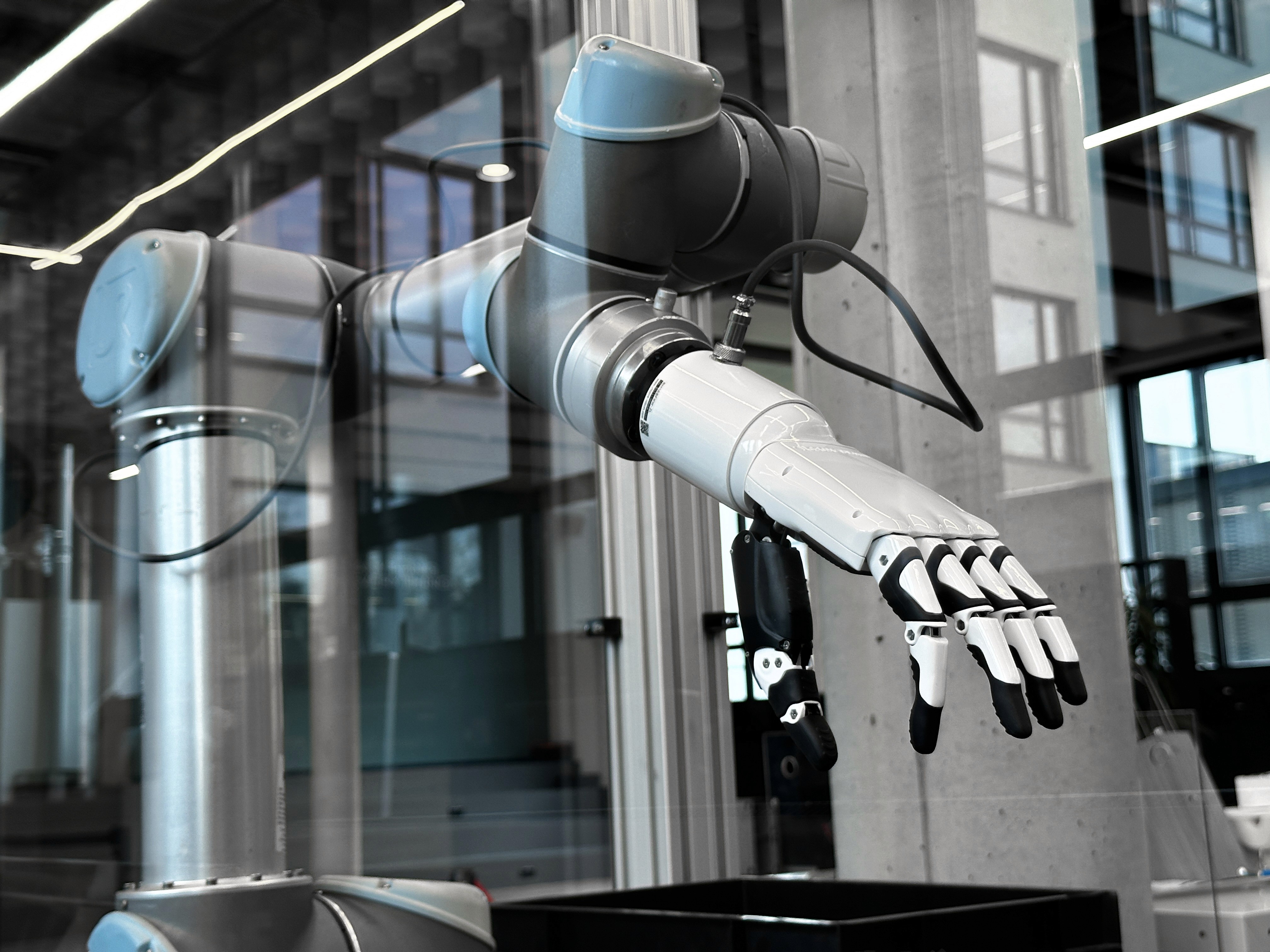
Grasping, solved for production

The chain that runs from camera to grasp. It locates the part, works out how to hold it, and moves the robot to pick it up without new tooling, a new program or engineering time for each part.

Grasping, solved for production

The chain that runs from camera to grasp. It locates the part, works out how to hold it, and moves the robot to pick it up without new tooling, a new program or engineering time for each part.

What is HandOS?

HandOS connects the standard industrial robot arm, the humanoid hand, and the vision system that locates the workpiece into a coherent system – enabling them to perform meaningful tasks together.

The modules run together or on their own, depending on what the application needs.

When the part changes, the software adapts without rebuilding the robot cell or writing a new program for every variant.

HandOS connects the standard industrial robot arm, the humanoid hand, and the vision system that locates the workpiece into a coherent system – enabling them to perform meaningful tasks together.

The modules run together or on their own, depending on what the application needs.

When the part changes, the software adapts without rebuilding the robot cell or writing a new program for every variant.

One Platform, Different Modules

For exploration and real world applications.

self.grasp

If you have a humanoid hand and want to see what it can do. One module, ready to run on its own, no cell required.

Hand Control

Control the hand directly.

Set the joint positions or force thresholds, then issue the command and see if the grasp holds on your own parts.

auto.grasp

Identifies the part, tracks it via camera, chooses the grasp and runs it. Four modules that run inside one application.

mdi

Grasp Generation

Computes possible grasps.

Takes a part it has not seen before and works out how it can be held.

Vision

Identifies the part.

Locates the part via camera and tracks it while it moves.

Grasp Execution

Chooses the right grasp and executes it.

Selects from the computed grasps and executes the motion on the cell.

Arm Control

Drives the arm carrying the hand.

Moves the industrial robot arm through approach, lift and place.

The part changes. The software adapts.

Conventional automation often requires new tooling and programming for each variant. With HandOS the robot cell adapts to the new part automatically, without need for retooling or reprogramming.

Where HandOS fits

Two places where part variation breaks the economics of conventional automation.

Two places where part variation breaks the economics of conventional automation.

In the Plant

The parts change and require a new EOAT and programming

Long runs are automated. The station where parts change from batch to batch is not. A new fixture and a new program for every variant cost more than the labour they save, so someone keeps loading the machine by hand.

In the Lab

The hand is on the bench, not in the cell.

You bought a multi-finger hand. Getting from a demo to something a production engineer signs off means controlling it, seeing the part, and picking a grasp that holds. Most hands never get that far.

Built to Adapt. Built to Integrate.

A learned grasp model trained on parts and grasps, built to run on standard industrial robotics hardware.

A single platform delivering precise manipulation, real-time control,
and seamless industrial integration.

Learned Neural Network

Grasp generation runs on an LNN, a Learned Neural Network and gets refined through AI. Similarly to a large language model that is trained on text; our LNN is trained on parts, 3D data and feedback loops from grasps that have run in both simulation and the real world.

Learned Neural Network

Grasp generation runs on an LNN, a Learned Neural Network and gets refined through AI. Similarly to a large language model that is trained on text; our LNN is trained on parts, 3D data and feedback loops from grasps that have run in both simulation and the real world.

Runs on what you already have.

Standard industrial robot arms. Multi-finger hands. Camera systems. Several of each, with us recommending you the best we can identify. It is possible to upgrade existing hardware.

Runs on what you already have.

Standard industrial robot arms. Multi-finger hands. Camera systems. Several of each, with us recommending you the best we can identify. It is possible to upgrade existing hardware.

Who should use HandOS?

HandOS is built for you if part variance is the reason a workstation is still manual. It it also a fit, if you want to experiment with humanoid hands and learn how to control them.

You are likely a fit if you have:

  • Machine tending or commissioning processes, where parts change from batch to batch and a new fixture, gripper or program per variant cannot be justified.

  • Logistics processes require your workers to unpack or offload boxes or pallets, with either part variance as a challenge or carton/ foil removal

  • You already own a multi-finger hand and it has not moved into demonstration or production.

If you can clearly use vacuum grippers or simple parallel grippers, HandOS will most likely not be a fit.

Join the waitlist

We will write to you once, when HandOS opens to industrial users. Nothing else.

Grasping, solved for production

The layer between the arm, the hand and the part in front of them. It handles parts that change, without new tooling, a new program or engineering time for each part.