Technology
At Prehensio, we don’t reinvent the wheel, we build on what works.
Tech
At Prehensio, we don’t reinvent the wheel, we build on what works.
Technology
At Prehensio, we don’t reinvent the wheel, we build on what works.
Inventing What Was Missing. Leveraging What Already Works.
Prehensio adds the missing intelligence layer required for physical automation to operate reliably under real factory conditions. Rather than replacing proven industrial hardware, the system builds on existing robots, sensors, and controllers - introducing software that enables adaptation during execution.
What was missing was not more hardware, but a way to fuse perception, motion, and contact into a single, continuous execution layer. Validated on real customer parts in an industrially representative lab setup.
Prehensio adds the missing intelligence layer required for physical automation to operate reliably under real factory conditions. Rather than replacing proven industrial hardware, the system builds on existing robots, sensors, and controllers - introducing software that enables adaptation during execution.
What was missing was not more hardware, but a way to fuse perception, motion, and contact into a single, continuous execution layer. Validated on real customer parts in an industrially representative lab setup.
Software-Defined Manipulation for High-Mix Industrial Automation
Prehensio develops a software-first manipulation platform that enables industrial robots to handle high part variability without manual reprogramming or custom tooling. The system is designed for high-mix, low-volume (HMLV) production environments, where frequent product changes, small batch sizes, and geometric variability make conventional automation economically unviable.
At the core of the problem is manipulation complexity. In variant-rich production, each new part typically requires a dedicated end-of-arm tool, manual robot programming, validation, and repeated changeovers. This engineering overhead dominates productive runtime, reduces overall equipment effectiveness (OEE), and prevents automation from scaling across variants.
Prehensio removes this constraint by shifting manipulation from hardware and manual programming to software.
Core Architecture
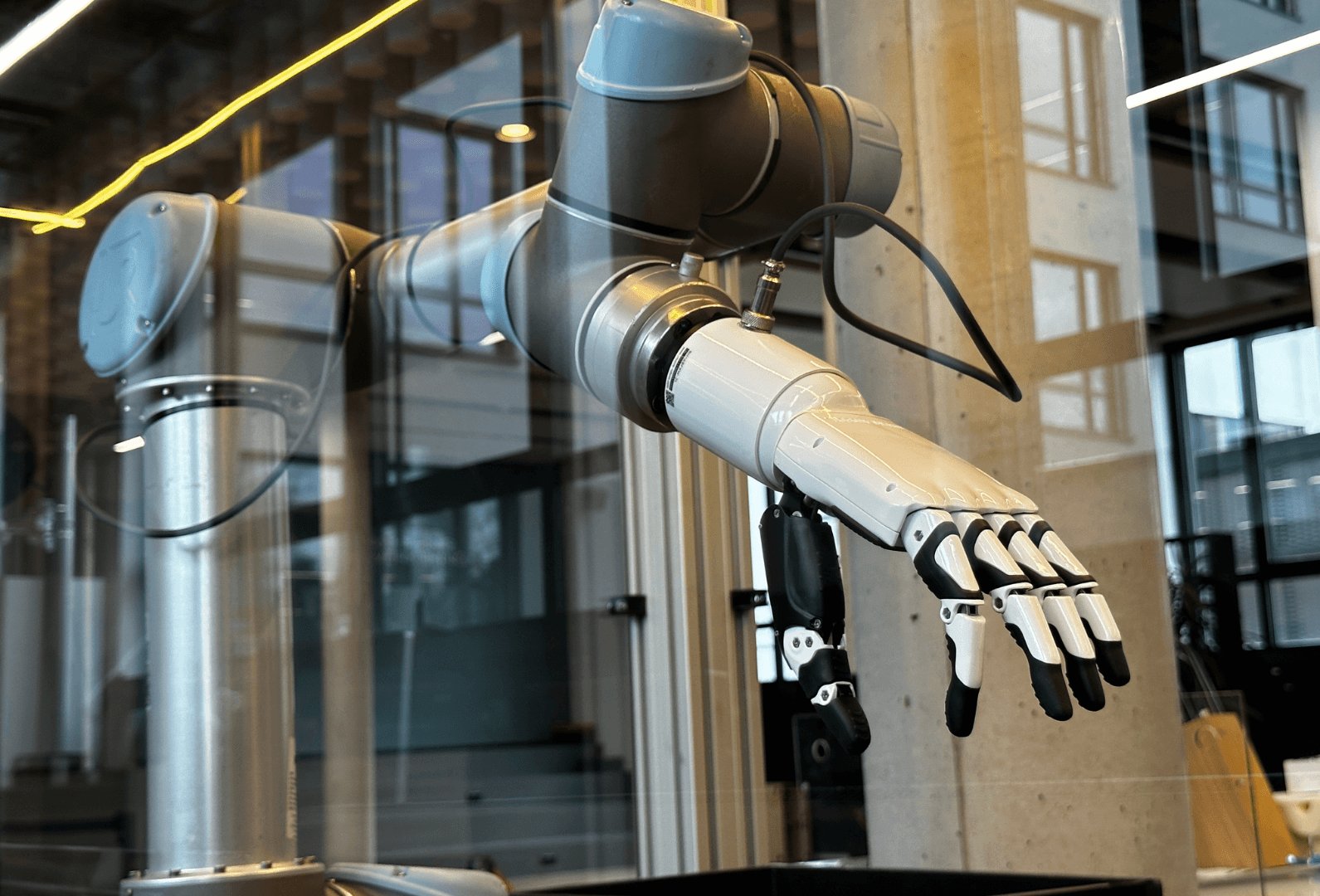
The Prehensio system runs as a software layer inside a standard industrial robot cell. It integrates with commercially available six-axis robots, dexterous five-finger robotic hands, and common industrial vision systems. No proprietary robot hardware is required.
The software combines perception, simulation, and learned control policies to enable a single robotic hand to grasp, reorient, inspect, and place diverse parts without task-specific tooling. Instead of programming individual motions, operators define objectives and constraints at a higher level.
The result is a software-defined manipulation cell that adapts across part variants while preserving industrial requirements for reliability, cycle time, and integration.
Learned Manipulation Policies
Manipulation is executed using learned control policies trained in simulation and transferred to real robotic cells. These policies enable stable grasping, in-hand reorientation, and controlled placement across varying geometries and tolerances.
Generalization across part variants is achieved by clustering parts into families based on geometry and topology. This reduces onboarding effort from individual SKUs to a manageable number of representative classes, allowing new variants to be deployed with minimal additional training.
The system is designed to operate within defined safety and performance envelopes and integrates with standard industrial controllers.
Digital Twin and Simulation-Driven Onboarding
A physics-accurate digital twin of the robotic hand and cell forms the basis for training and validation. Using simulation, manipulation policies are trained and tested before deployment, reducing commissioning time and risk on the shop floor.
Operators can onboard new parts using CAD models or scans, select relevant constraints, and validate feasibility in simulation before deploying to production. This enables fast changeovers and allows automation decisions to be evaluated before physical integration.
Simulation-based workflows replace large parts of manual teaching and revalidation that traditionally dominate high-mix automation projects.
Continuous Improvement in Production
During operation, the system collects runtime telemetry such as grasp success, slip events, dwell times, and placement accuracy. This data feeds controlled improvement loops that refine policies over time without interrupting production.
The platform integrates with PLC and MES systems to support recipe management, traceability, and quality documentation, enabling deployment in regulated industrial environments.
Scope and Current Maturity
Version 1 of the system focuses on machine tending, commissioning, and kitting applications with small to medium rigid parts. The technology is designed for industrial deployment, prioritizing robustness, repeatability, and integration over experimental generality.
The platform builds on Fraunhofer-originated research in robotic manipulation and is developed by a team with deep experience in reinforcement learning, simulation, and industrial cell integration. Multiple physical prototypes are in operation, and pilot deployments with industrial partners are underway.
Prehensio develops a software-first manipulation platform that enables industrial robots to handle high part variability without manual reprogramming or custom tooling. The system is designed for high-mix, low-volume (HMLV) production environments, where frequent product changes, small batch sizes, and geometric variability make conventional automation economically unviable.
At the core of the problem is manipulation complexity. In variant-rich production, each new part typically requires a dedicated end-of-arm tool, manual robot programming, validation, and repeated changeovers. This engineering overhead dominates productive runtime, reduces overall equipment effectiveness (OEE), and prevents automation from scaling across variants.
Prehensio removes this constraint by shifting manipulation from hardware and manual programming to software.
Core Architecture
The Prehensio system runs as a software layer inside a standard industrial robot cell. It integrates with commercially available six-axis robots, dexterous five-finger robotic hands, and common industrial vision systems. No proprietary robot hardware is required.
The software combines perception, simulation, and learned control policies to enable a single robotic hand to grasp, reorient, inspect, and place diverse parts without task-specific tooling. Instead of programming individual motions, operators define objectives and constraints at a higher level.
The result is a software-defined manipulation cell that adapts across part variants while preserving industrial requirements for reliability, cycle time, and integration.
Learned Manipulation Policies
Manipulation is executed using learned control policies trained in simulation and transferred to real robotic cells. These policies enable stable grasping, in-hand reorientation, and controlled placement across varying geometries and tolerances.
Generalization across part variants is achieved by clustering parts into families based on geometry and topology. This reduces onboarding effort from individual SKUs to a manageable number of representative classes, allowing new variants to be deployed with minimal additional training.
The system is designed to operate within defined safety and performance envelopes and integrates with standard industrial controllers.
Digital Twin and Simulation-Driven Onboarding
A physics-accurate digital twin of the robotic hand and cell forms the basis for training and validation. Using simulation, manipulation policies are trained and tested before deployment, reducing commissioning time and risk on the shop floor.
Operators can onboard new parts using CAD models or scans, select relevant constraints, and validate feasibility in simulation before deploying to production. This enables fast changeovers and allows automation decisions to be evaluated before physical integration.
Simulation-based workflows replace large parts of manual teaching and revalidation that traditionally dominate high-mix automation projects.
Continuous Improvement in Production
During operation, the system collects runtime telemetry such as grasp success, slip events, dwell times, and placement accuracy. This data feeds controlled improvement loops that refine policies over time without interrupting production.
The platform integrates with PLC and MES systems to support recipe management, traceability, and quality documentation, enabling deployment in regulated industrial environments.
Scope and Current Maturity
Version 1 of the system focuses on machine tending, commissioning, and kitting applications with small to medium rigid parts. The technology is designed for industrial deployment, prioritizing robustness, repeatability, and integration over experimental generality.
The platform builds on Fraunhofer-originated research in robotic manipulation and is developed by a team with deep experience in reinforcement learning, simulation, and industrial cell integration. Multiple physical prototypes are in operation, and pilot deployments with industrial partners are underway.
From Automation Challenge to Deployed Dexterity
How we evaluate and validate automation before deploying it onsite
Intro Call
We have an online meeting to understand your challenge, your parts and requirements. You understand where we can perform and we decide if we build a use-case analysis.
Use-Case
Changeover times, Variants, Tolerances: We answer the question if our solution is technically and economically viable for your operation is together.
Virtual Simulation
Test feasibility before touching the floor: We simulate your process digitally to confirm if our model can work accurately and establish levels of confidence.
Deployment
Once confirmed, we deploy on-site. You get real-time performance, continuous monitoring, and adaptation to new parts.
Support
From updates to system tuning, we stick with you after deployment. Our team ensures your new robotic worker performs.
Common Deployment Questions! (FAQs)
Technical and operational considerations for deploying Prehensio in production.